Report to Congress Show Army leads Military Branches in Domestic Violence; Servicemember Bias and Negative Repercussions are Reported as a Barriers to Reporting.
May 24, 2023
“The U.S. Government Accountability Office (GOA), often called the ‘congressional watchdog,’ is an independent, non-partisan agency that works for Congress. GAO examines how taxpayer dollars are spent and provides Congress and federal agencies with objective, non-partisan, fact-based information to help the government save money and work more efficiently.”
In 2021, GOA released a report analyzing: the military services’ efforts to prevent and respond to domestic abuse. GAO:
- Reviewed program data, policies, and guidance
- Documents from a non-generalized sample of 20 military installations
- Interviewed sixty-eight abuse survivors
- Interviewed Department of Defense (DOD), service and civilian officials.
In GAO’s Watchdog Report, Brenda Farrell, a director in GAO’s Defense Capabilities and Management Team state that the DOD had not collected nor reported accurate and complete data on domestic abuse as required by law. She states that it is difficult to even compare DV across the branches, as the incidents are collected differently by each branch; for example, The Navy and the Marine Corps document each allegation as a separate offense, while the Army documents multiple allegations as a single data record. This type of reporting by the Army, under-reports their numbers of allegations compared to Branches like the Navy and Marines.
The Full Report on Domestic Abuse to congressional committees is 165 pages.
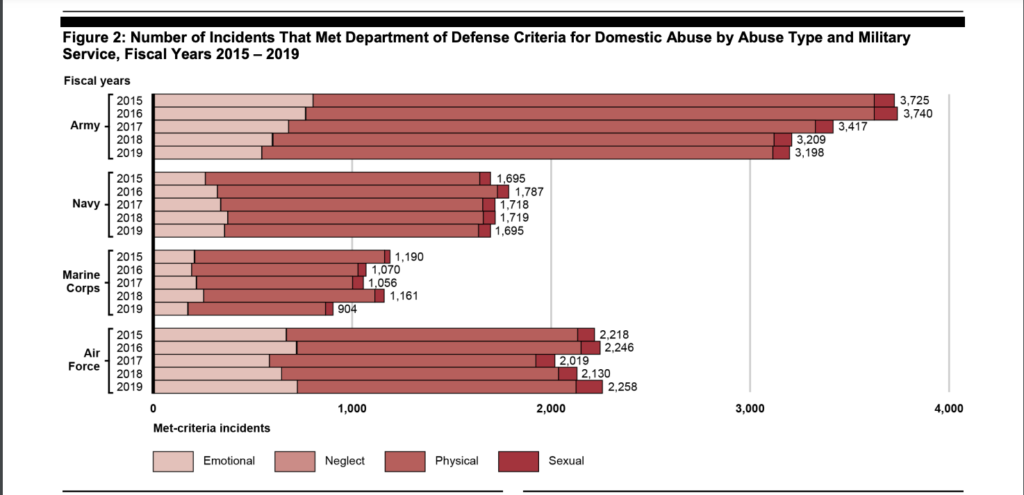
Even with the Army clumping multiple reports as one, they are leading the pack with a huge majority of Domestic Violence Incidents that met DOD’s criteria for domestic abuse; which is further recognized as emotional, neglect, physical, and sexual abuses.
GAO also reported that “the Army data reported to DOD FAP for fiscal years 2015 through 2017 inaccurately indicated that no victims of abuse had been service members.” The Army has stated that they are going through manually to make edits to their previous false reporting.
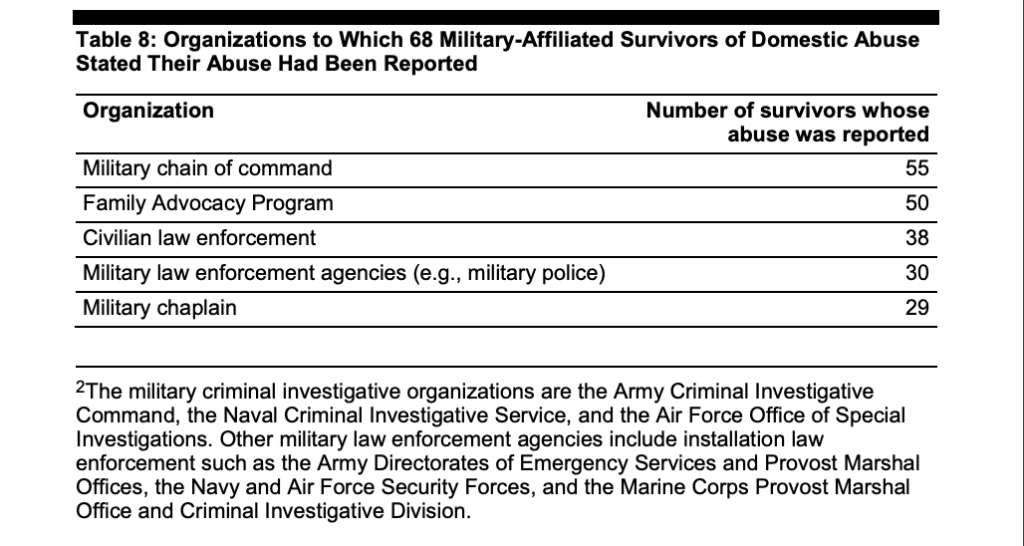
For GAO’s report, from May through June, 2020, they interviewed sixty-eight survivors of domestic abuse who were service members, spouses, or intimate partners at the time of the abuse. Of the sixty-eight, sixty-two reported their abuser was an active-duty service member, and thirty-four were associated with the Army. Survivors were also questioned about where they had reported their abuse and their answers included: the chain of command, Family Advocacy Program, civilian law enforcement, military law enforcement, and the military chaplain.
Of those sixty-eight who reported to these outlets, FIFTY-NINE stated that they had encountered barriers to reporting – two of the most listed barriers that kept the victim from reporting was the fact that the victim was financially dependent on the abuser and that they felt they would not be believed or taken seriously.
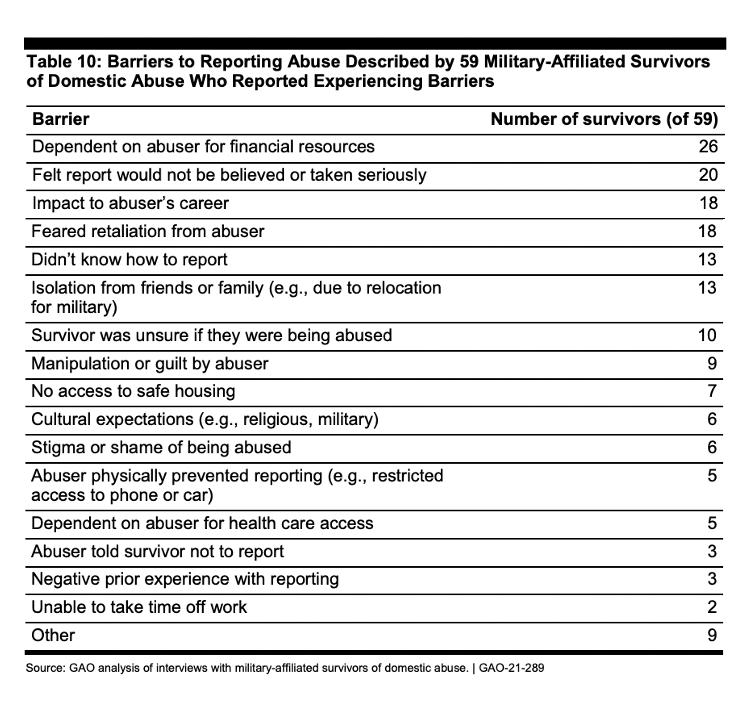
In addition to the already above barriers preventing victims to report abuse in the military, survivors survey went on to report that they told an official about the abuse but that the felt no actions were taken; that they were ignored, and not taken seriously and that the official even attempted to defend the actions of the abuser. “In some cases, survivors described negative actions that resulted from these attempts to report, such as being given a letter of reprimand or being ridiculed by members of their abuser’s command or unit.”
Fifty of the surveyed survivors identified as a civilian spouse or intimate partner of a service member. The majority of these civilian partners believed the military was biased towards and attempted to protect the service member. In addition, they felt that it was difficult to access information and that the resources were mainly geared toward service members. In the case of the Army, it is interesting to note that the Incident Determination Committee (IDC), who votes to determine whether the incident meets criteria of abuse is made up of the abuser’s command, senior command in charge of the installation or garrison, representatives from military law enforcement personnel, representatives from FAP. This is the bias that the I Am Vanessa Guillen Act is fighting for – to remove from investigations and prosecution decisions from the Chain of Command and into the hands of an independent investigators.
- GAO Website: Domestic Abuse: Actions Needed to Enhance DOD’s Prevention, Response, and Oversight. May 06, 2021.
- GAO Full Report to Congressional Committees, Domestic Abuse. May 2021
- WomensLaw.org. Domestic Violence in the Military. October 09, 2019
- The Texas Tribune. New law named for Vanessa Guillen will revamp military investigations into sexual assault, harassment. December, 29, 2021. Larson, Ren
- Dianne Feinstein Press Release. Senators Introduce Legislation to Remove Sexual Harrassment Cases from Military Chain of Command. April 28, 2022.

You May Also Like